Color
Hue, tone, saturation, uniformity, zoning, and market preference can strongly affect value.
Gemstones are natural materials valued for beauty, rarity, durability, color, optical character, and cultural significance. Their value can vary dramatically depending on quality, origin, treatment, size, certification, and market demand.
A gemstone is a mineral, rock, or organic material selected for characteristics such as beauty, rarity, durability, color, optical effects, or cultural importance. Many gemstones are cut and polished for jewelry, while others are collected as mineral specimens or used in specialized industrial applications.
Gemstones do not behave like standardized commodity metals. Two stones with the same mineral name and weight can have very different values because quality, treatment, geographic origin, certification, and market preferences may differ substantially.
The gemstone world includes highly recognized precious stones, major colored gems, mineral varieties, and collector materials.
Famous for exceptional hardness, brilliance, jewelry use, and demanding industrial applications.
View Diamond → CORUNDUMRed gem-quality corundum valued for color, transparency, rarity, origin, and quality.
View Ruby → CORUNDUMCorundum occurring in blue and many other colors, with major jewelry and collector markets.
View Sapphire → BERYLGreen beryl valued for rich color, rarity, origin, clarity characteristics, and historical significance.
View Emerald → SILICA MATERIALKnown for distinctive play-of-color and major deposits in Australia and other regions.
View Opal → BERYLBlue to blue-green beryl appreciated for clarity, color, crystal size, and durability.
View Aquamarine → MINERAL GROUPA diverse gemstone group occurring in a remarkable range of colors and combinations.
View Tourmaline → SILICATE MINERALA durable gem mineral occurring in colorless, blue, yellow, pink, orange, brown, and other varieties.
View Topaz →Gemstone pricing is highly stone-specific. Several characteristics can influence desirability and market value at the same time.
Hue, tone, saturation, uniformity, zoning, and market preference can strongly affect value.
Inclusions, fractures, transparency, and how internal features affect appearance matter.
Proportions, symmetry, polish, shape, orientation, and light performance influence beauty.
Larger high-quality stones can become disproportionately rarer as weight increases.
Geographic provenance can matter when certain deposits have historical or market significance.
Heat, filling, irradiation, diffusion, impregnation, and other treatments may affect value.
Scarcity of the mineral, color, quality level, size, or deposit can influence demand.
Independent gemological reports can document identification, treatments, and certain quality characteristics.
Gem names sometimes describe varieties of the same underlying mineral rather than completely different mineral species.
Aluminum oxide forms both ruby and sapphire. Trace elements and color determine the gem variety.
Beryl produces several major gemstones depending on chemistry and color.
Quartz is abundant, but attractive gem varieties can be prized for color, clarity, and crystal form.
Garnet describes a group of related minerals with multiple gem varieties and colors.
Formed through geological processes and recovered from natural deposits.
Produced in controlled environments with essentially the same crystal material as the natural gemstone counterpart.
Natural material altered to improve color, clarity, durability, or appearance.
A different material made or selected to resemble another gemstone visually.
Gemstones form through different geological environments involving heat, pressure, fluids, magma, weathering, and sediment transport.
Crystallization from magma, pegmatites, volcanic environments, and related hydrothermal fluids can form gem minerals.
Heat, pressure, and fluid movement can transform existing rocks and produce new minerals.
Mineral-rich hot fluids moving through fractures can deposit crystals in favorable geological settings.
Resistant gems can survive erosion, become concentrated by water, and accumulate in stream or gravel deposits.
Gemstones occur worldwide, but some countries and regions are strongly associated with particular gems, deposits, colors, or historically important production.
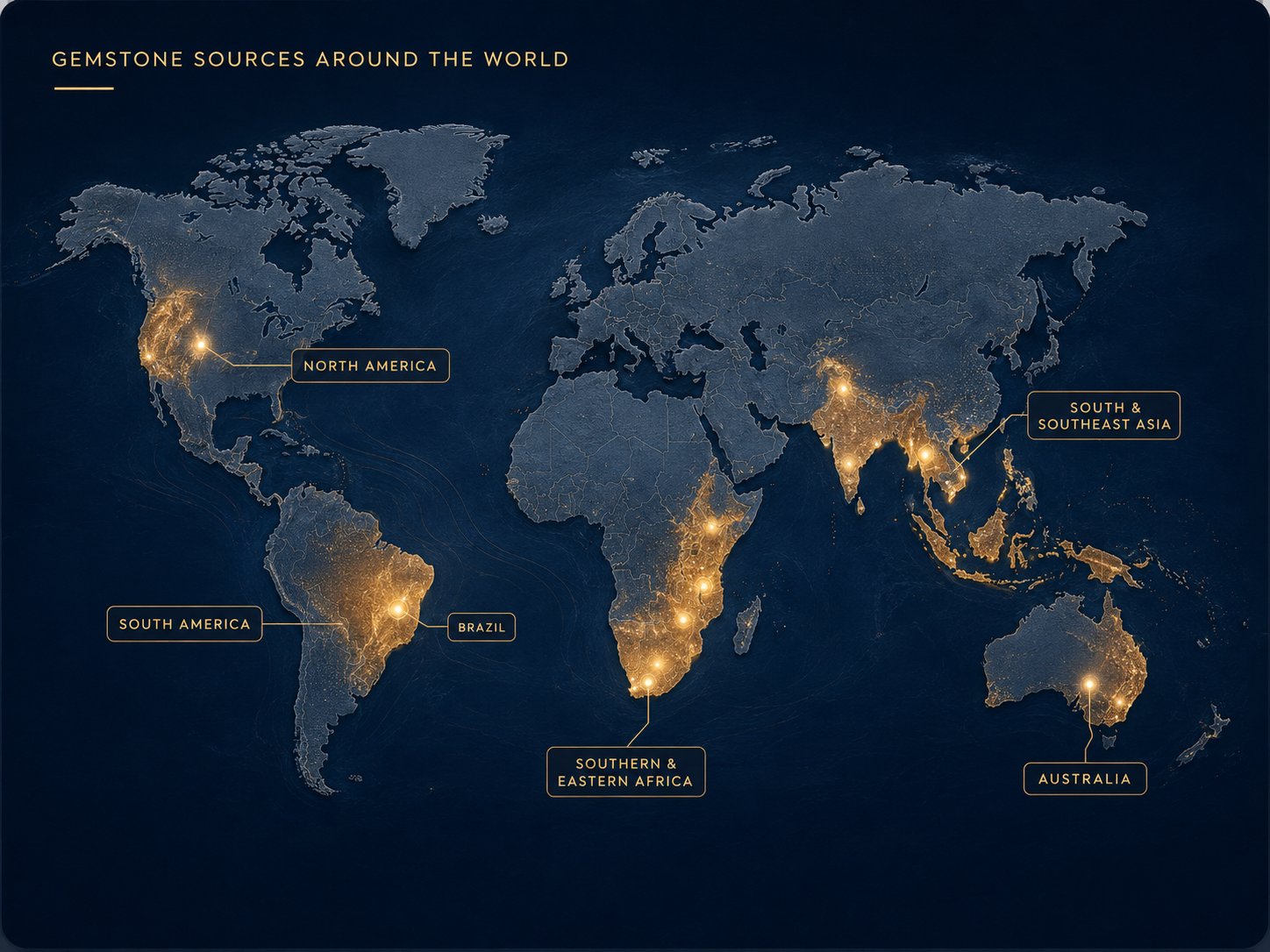
Diamonds, emeralds, rubies, sapphires, garnets, tourmalines, and other gems.
Sapphire, ruby, spinel, jade, and historically important colored gemstone deposits.
Emerald, tourmaline, aquamarine, quartz varieties, topaz, and other gem materials.
Opal, sapphire, diamond, and other notable gemstone resources.
Diamond, sapphire, turquoise, garnet, tourmaline, and numerous collectible gem minerals.
Hardness measures resistance to scratching. It is useful, but toughness, cleavage, fractures, and stability also affect gemstone durability.
Mohs hardness is ordinal rather than a linear measure of absolute hardness.
Rings, necklaces, bracelets, earrings, watches, decorative settings, and luxury objects.
Fine mineral specimens, crystals, rare varieties, unusual formations, and historically important material.
Diamond, corundum, quartz, and other minerals can serve cutting, grinding, optical, and technical functions.
Certain synthetic and natural crystal materials are used in lasers, optics, electronics, sensors, and research.
Search major gemstone types, mineral varieties, and gem materials.
Precious, industrial, strategic, and specialty metals.
02Minerals used in construction, manufacturing, agriculture, and everyday products.
03Strategically important materials with economic and supply-chain significance.
04A gemstone and industrial material with unusual hardness and physical properties.
Earth Value Index uses geological surveys, mineralogical references, gemological organizations, academic sources, government agencies, and clearly identified industry references when describing gemstone geology, deposits, treatments, properties, uses, and markets.
Browse metals, minerals, gemstones, critical materials, energy resources, and the products and systems that depend on them.